
Table of Contents
UNITED STATES
SECURITIES AND EXCHANGE COMMISSION
Washington, D.C. 20549
SCHEDULE 14A
Proxy Statement Pursuant to Section 14(a)
of the Securities Exchange Act of 1934 (Amendment No. )
Filed by the Registrant ☒
Filed by a Party other than the Registrant ☐
Check the appropriate box:
| ☒ | Preliminary Proxy Statement |
| ☐ | Confidential, for Use of the Commission Only (as permitted by Rule 14a-6(e)(2)) |
| ☐ | Definitive Proxy Statement |
| ☐ | Definitive Additional Materials |
| ☐ | Soliciting Material Pursuant to §240.14a-12 |
TSCAN THERAPEUTICS, INC.
(Name of Registrant as Specified in its Charter)
(Name of Person(s) Filing Proxy Statement, if other than the Registrant)
Payment of Filing Fee (Check the appropriate box):
| ☒ | No fee required. |
| ☐ | Fee paid previously with preliminary materials. |
| ☐ | Fee computed on table in exhibit required by Item 25(b) per Exchange Act Rules 14a-6(i)(1) and 0-11. |
Table of Contents
PRELIMINARY PROXY STATEMENT – SUBJECT TO REVIEW
TSCAN THERAPEUTICS, INC.
830 Winter Street
Waltham, MA 02451
NOTICE OF SPECIAL MEETING OF STOCKHOLDERS
To be held November 20, 2026
Notice is hereby given that a Special Meeting of Stockholders (the “Special Meeting”) of TScan Therapeutics, Inc. (the “Company” or “we”), will be held online on November 20, 2026, at 8:30 a.m. Eastern Time. You may attend the meeting virtually via the Internet at www.virtualshareholdermeeting.com/TCRX2026SM, where you will be able to vote electronically and submit questions. You will need the 16-digit control number included with this Proxy Statement and the accompanying proxy card (the “Proxy Materials”) in order to attend the Special Meeting. The purpose of the Special Meeting is the following:
| 1. | To approve an amendment to the Company’s amended and restated certificate of incorporation (“Certificate of Incorporation”) to combine outstanding shares of the Company’s common stock, par value $0.0001 per share, which consists of voting common stock and non-voting common stock, into a lesser number of outstanding shares (the “Reverse Stock Split”), by a ratio of not less than one-for-two and not more than one-for-fifty, with the exact ratio to be set within this range by our board of directors in its sole discretion (the “Reverse Stock Split Proposal”); and |
| 2. | The approval of an adjournment of the Special Meeting, if necessary, to permit further solicitation and vote of proxies in the event that there are insufficient votes in favor of the Reverse Stock Split Proposal (the “Adjournment Proposal”). |
Only the Company’s stockholders of record at the close of business on October 16, 2026, the record date for the Special Meeting, are entitled to notice of, and to vote at, the Special Meeting or any adjournment or postponement of the Special Meeting.
You can find more information on each of the matters to be voted on at the Special Meeting in the accompanying Proxy Statement. The board of directors recommends a vote “FOR” the Reverse Stock Split Proposal and “FOR” the Adjournment Proposal.
The Company has elected to use the full set delivery option available pursuant to Rule 14a-16(n) under the Securities Exchange Act of 1934, as amended (the “Exchange Act”). Under the full set delivery option, the Company will deliver the Proxy Materials to stockholders by mail. In addition to delivery of the Proxy Materials to stockholders, the Company will post all Proxy Materials on a publicly-accessible website and provide information to stockholders about how to access the website.
Whether or not you expect to attend the Special Meeting online, we encourage you to read the accompanying Proxy Statement and vote your shares as promptly as possible to ensure your representation and the presence of a quorum at the Special Meeting on the Internet as described in the instructions included in the Proxy Materials, by telephone by calling 1-800-690-6903 and following the recorded instructions, by internet at www.proxyvote.com, or by signing, dating and returning the enclosed proxy card. If you vote your shares on the Internet or by telephone, you will need to enter the 16-digit control number provided in the Proxy Materials.
Your vote is important regardless of the number of shares you own. If you attend the Special Meeting online, you may vote your shares during the Special Meeting virtually via the Internet even if you previously voted your proxy. Your proxy is revocable in accordance with the procedures set forth in the Proxy Statement.
If your shares are held in “street name,” that is, held for your account by a broker or other nominee, you will receive instructions from the holder of record that you must follow for your shares to be voted.
A list of stockholders as of the close of business on the record date will be available for examination by our stockholders of record during the Special Meeting using the unique link provided via email following the completion of registration on the meeting website www.virtualshareholdermeeting.com/TCRX2026SM. Further information about how to complete registration for the meeting website, attend the Special Meeting online, vote your shares and submit questions is included in the accompanying proxy statement.
| By order of the board of directors, | ||
| /s/ Gavin MacBeath | ||
| Gavin MacBeath, Ph.D. | ||
| Chief Executive Officer | ||
Waltham, Massachusetts
October , 2026
Table of Contents
PRELIMINARY PROXY STATEMENT – SUBJECT TO REVIEW
| Page | ||||
| 1 | ||||
| 2 | ||||
| 8 | ||||
| 20 | ||||
| 21 | ||||
| 25 | ||||
| 25 | ||||
| 26 | ||||
i
Table of Contents
TSCAN THERAPEUTICS, INC.
830 Winter Street
Waltham, MA 02451
FOR THE SPECIAL MEETING OF STOCKHOLDERS
TO BE HELD ON NOVEMBER 20, 2026
This proxy statement (this “Proxy Statement”) contains information about the Special Meeting of Stockholders (the “Special Meeting”) of TScan Therapeutics, Inc. (“TScan,” the “Company,” “we,” “us,” and “our”), which will be held on November 20, 2026, at 8:30 a.m. Eastern Time. The board of directors of the Company (the “board of directors”) is using this Proxy Statement to solicit proxies for use at the Special Meeting. The mailing address of our principal executive office is TScan Therapeutics, Inc., 830 Winter Street, Waltham, MA 02451.
In order to attend the Special Meeting virtually, you must log into the meeting at www.virtualshareholdermeeting.com/TCRX2026SM. We encourage you to access the Special Meeting before it begins. Online log-in to access the Special Meeting will start shortly before the meeting on November 20, 2026. You will be required to complete the registration by entering the control number provided in the Proxy Materials, your name and your email address at www.virtualshareholdermeeting.com/TCRX2026SM. Beneficial owners of shares held in street name will need to register as well, and also follow the instructions provided in the voting instructions form by the broker, bank or other nominee that holds their shares. Please see the “General Information” section of this Proxy Statement for more details regarding the logistics of the virtual Special Meeting. The Special Meeting will be held virtually only. There will be no physical meeting location, and you will not be able to attend the Special Meeting in person.
All properly submitted proxies will be voted in accordance with the instructions contained in those proxies. If no instructions are specified, the proxies will be voted in accordance with the recommendation of our board of directors with respect to each of the matters set forth in the accompanying notice of meeting. You may revoke your proxy at any time before it is exercised at the meeting by giving our corporate secretary written notice to that effect.
We made this Proxy Statement available to stockholders on or about , 2026.
Important Notice Regarding the Availability of Proxy Materials for the Special Meeting of Stockholders to be Held on November 20, 2026
This Proxy Statement is available for viewing, printing and downloading at www.virtualshareholdermeeting.com/TCRX2026SM.
A copy of our Annual Report, as filed with the Securities and Exchange Commission, except for exhibits, will be furnished without charge to any stockholder upon written request to TScan Therapeutics, Inc., 830 Winter Street, Waltham, MA 02451, Attention: Corporate Secretary. This Proxy Statement and our Annual Report are also available on the SEC’s website at www.sec.gov.
1
Table of Contents
TSCAN THERAPEUTICS, INC.
PROXY STATEMENT
FOR THE SPECIAL MEETING OF STOCKHOLDERS
When are this Proxy Statement and the accompanying materials scheduled to be sent to stockholders?
We anticipate on or about , 2026, we will begin mailing the Proxy Materials or, for shares held in street name (i.e., held for your account by a broker, bank or other nominee), a voting instruction form, will be mailed and made available to stockholders on the Internet on or about the same date.
Who is soliciting my vote?
Our board of directors is soliciting your vote for the Special Meeting.
When is the record date for the Special Meeting?
The record date for determination of stockholders entitled to vote at the Special Meeting is the close of business on October 16, 2026.
How many votes can be cast by all stockholders?
There were shares of our voting common stock, par value $0.0001 per share, outstanding on October 16, 2026, all of which are entitled to vote with respect to all matters to be acted upon at the Special Meeting. Each stockholder of record is entitled to one vote for each share of our voting common stock held by such stockholder. None of our shares of undesignated preferred stock were outstanding as of October 16, 2026. No stockholders have cumulative voting rights. As of October 16, 2026, there were 4,276,588 shares of non-voting common stock, par value $0.0001 per share, outstanding. The shares of non-voting stock are not entitled to vote on the proposals presented at the Special Meeting.
Who is entitled to vote?
Registered Stockholders. If shares of our common stock are registered directly in your name with our transfer agent, you are considered the stockholder of record with respect to those shares. As the stockholder of record, you have the right to grant your voting proxy directly to the individuals listed on the proxy card or vote on your own behalf at our virtual Special Meeting. Throughout this Proxy Statement, we refer to these registered stockholders as “stockholders of record.”
Street Name Stockholders. If shares of our common stock are held on your behalf in a brokerage account or by a bank or other nominee, you are considered to be the beneficial owner of shares that are held in “street name,” and the proxy materials were forwarded to you by your broker or nominee, who is considered the stockholder of record with respect to those shares. As the beneficial owner, you have the right to direct your broker, bank or other nominee as to how to vote your shares. Beneficial owners are also invited to attend our virtual Special Meeting. However, since a beneficial owner is not the stockholder of record, you may not vote your shares of our common stock on your own behalf at the Special Meeting unless you follow your broker’s procedures for obtaining a legal proxy. Note that you should also be receiving a voting instruction form for you to use from your broker. Throughout this Proxy Statement, we refer to stockholders who hold their shares through a broker, bank or other nominee as “street name stockholders.”
2
Table of Contents
How do I vote?
If you are a stockholder of record, and your shares are registered directly in your name, there are several ways for you to vote your shares.
| • | By Internet. You may vote at www.proxyvote.com, or scan the QR barcode on your proxy card, 24 hours a day, seven days a week. Use the internet to transmit your voting instructions and for electronic delivery information. You will need the 16-digit control number included in your Proxy Materials. Votes submitted through the Internet must be received by 11:59 p.m. Eastern Time, on November 19, 2026. Have your proxy card in hand when you access the website and follow the instructions to obtain your records and to create an electronic voting instruction form. |
| • | By Telephone. You may vote using a touch-tone telephone by calling 1-800-690-6903, 24 hours a day, seven days a week. You will need the 16-digit control number included in your Proxy Materials. Votes submitted by telephone must be received by 11:59 p.m. Eastern Time, on November 19, 2026. Have your proxy card in hand when you call and then follow the instructions. |
| • | By Mail. You may vote by mail by completing, signing and dating the enclosed proxy card and returning it in the enclosed prepaid envelope we have provided or return it to Vote Processing, c/o Broadridge, 51 Mercedes Way, Edgewood, NY 11717. Votes submitted through the mail must be received by Broadridge Financial Solutions, Inc. not later than the close of business November 19, 2026, the day before the Special Meeting, for your vote to count. |
| • | During the Special Meeting. You may vote during the Special Meeting by going to www.virtualshareholdermeeting.com/TCRX2026SM and following the instructions on that website for submitting your vote. You will be required to complete the registration by entering the control number provided in your Proxy Materials, your name and your email address. If you vote by proxy prior to the Special Meeting and choose to attend the Special Meeting online, there is no need to vote again during the Special Meeting unless you wish to change your vote. |
Even if you plan to attend our virtual Special Meeting, we recommend that you vote by proxy so that your vote will be counted if you later decide not to attend the Special Meeting. If the Special Meeting is adjourned or postponed, the deadlines above may be extended.
If you are a beneficial owner of shares held in “street name” by your broker, bank or other nominee, you should have received a voting instruction form with these proxy materials from your broker, bank or other nominee rather than from us. The voting deadlines and availability of telephone and Internet voting for beneficial owners of shares will depend on the voting processes of the broker, bank or other nominee that holds your shares. Therefore, we urge you to carefully review and follow the voting instruction form and any other materials that you receive from that organization. If you hold your shares of our voting common stock in multiple accounts, you should vote your shares as described in each set of proxy materials you receive.
If you submit a proxy without giving voting instructions, your shares will be voted in the manner recommended by the board of directors on all matters presented in this Proxy Statement, and as the persons named as proxies in the proxy card may determine in their discretion with respect to any other matters properly presented at the Special Meeting. You may also authorize another person or persons to act for you as proxy in a writing, signed by you or your authorized representative, specifying the details of those proxies’ authority. The original writing must be given to each of the named proxies, although it may be sent to them by electronic transmission if, from that transmission, it can be determined that the transmission was authorized by you.
If any other matters are properly presented for consideration at the Special Meeting, including, among other things, consideration of a motion to adjourn the Special Meeting to another time or place (including, without limitation, for the purpose of soliciting additional proxies), the persons named in your proxy and acting thereunder will have discretion to vote on those matters in accordance with their best judgment. We do not currently anticipate that any other matters will be raised at the Special Meeting.
3
Table of Contents
How can I virtually attend the Special Meeting?
To attend and participate in the Special Meeting, stockholders will need to access the live webcast of the meeting. To do so, stockholders of record will need to visit www.virtualshareholdermeeting.com/TCRX2026SM and complete the registration by entering the control number provided in the Proxy Materials along with your name and your email address, and beneficial owners of shares held in street name will need to follow the instructions provided in the voting instructions form by the broker, bank or other nominee that holds their shares.
The live webcast of the Special Meeting will begin promptly at 8:30 a.m. Eastern Time on November 20, 2026. We encourage stockholders to log in to this website and access the webcast before the Special Meeting’s start time. You should allow ample time in advance of the meeting.
Additionally, questions regarding how to attend and participate via the Internet can be answered by following the assistance instructions included at www.virtualshareholdermeeting.com/TCRX2026SM.
If you wish to submit a question during the Special Meeting, you may log into, and submit a question on, the virtual meeting platform following the completion of your registration at www.virtualshareholdermeeting.com/TCRX2026SM and following the instructions there. Our Special Meeting will be governed by the Special Meeting’s Rules of Conduct, which will address the ability of stockholders to ask questions during the meeting and rules for how questions will be recognized and addressed. The Special Meeting’s Rules of Conduct will be available on www.virtualshareholdermeeting.com/TCRX2026SM prior to the Special Meeting.
How can I get help if I have trouble checking in or listening to the meeting online?
There will be a support number available on the login page of the virtual meeting 15 minutes before the meeting begins for any stockholders having technical difficulties. The technical support line will not be able to provide control numbers but will be able to assist with any technical issues.
By Proxy
If you will not be attending the Special Meeting, you may vote by proxy. You can vote by proxy over the Internet by following the instructions provided in the enclosed proxy card. Proxies submitted by mail must be received before the close of business on November 19, 2026, the day before the Special Meeting, for your vote to count.
If you complete and submit your proxy before the applicable deadline, the persons named as proxies will vote the shares represented by your proxy in accordance with your instructions. If you submit a proxy without giving voting instructions, your shares will be voted in the manner recommended by the board of directors on all matters presented in this Proxy Statement, and as the persons named as proxies may determine in their discretion with respect to any other matters properly presented at the Special Meeting. You may also authorize another person or persons to act for you as proxy in a writing, signed by you or your authorized representative, specifying the details of those proxies’ authority. The original writing must be given to each of the named proxies, although it may be sent to them by electronic transmission if, from that transmission, it can be determined that the transmission was authorized by you.
If any other matters are properly presented for consideration at the Special Meeting, including, among other things, consideration of a motion to adjourn the Special Meeting to another time or place (including, without limitation, for the purpose of soliciting additional proxies), the persons named in your proxy and acting thereunder will have discretion to vote on those matters in accordance with their best judgment. We do not currently anticipate that any other matters will be raised at the Special Meeting.
How do I revoke my proxy?
If you are a stockholder of record, you may revoke your proxy by (i) following the instructions on the Proxy Materials and submitting a new vote by Internet, telephone or mail using the procedures described in the “How
4
Table of Contents
do I vote?” section above before the applicable deadline, (ii) attending and voting at the Special Meeting (although attendance at the Special Meeting will not in and of itself revoke a proxy), or (iii) filing an instrument in writing revoking the proxy or another duly executed proxy bearing a later date with our Corporate Secretary. Any written notice of revocation or subsequent proxy card must be received by our Corporate Secretary prior to the taking of the vote at the Special Meeting. Such written notice of revocation or subsequent proxy card should be hand delivered to our corporate secretary or sent to our principal executive offices at TScan Therapeutics, Inc., 830 Winter Street, Waltham, MA 02451, Attention: Corporate Secretary.
If a broker, bank, or other nominee holds your shares, you must contact such broker, bank, or nominee in order to find out how to change your vote.
How is a quorum reached?
Our amended and restated bylaws (the “bylaws”) provide that the holders of a majority in voting power of the shares of our capital stock issued and outstanding and entitled to vote at the meeting of stockholders, present in person or represented by proxy, shall constitute a quorum for the transaction of business at such meeting. Under the General Corporation Law of the State of Delaware, shares that are voted “abstain” or “withheld” and broker “non-votes” are counted as present for purposes of determining whether a quorum is present at the Special Meeting. If a quorum is not present, the meeting may be adjourned until a quorum is obtained. There were shares of our voting common stock outstanding and entitled to vote on the record date. Therefore, a quorum will be present if shares of our voting common stock are present in person or represented by executed proxies timely received by us at the Special Meeting. Shares present virtually during the Special Meeting will be considered shares of common stock represented in person at the meeting.
If you are a beneficial owner of shares held in a brokerage account and you do not instruct your nominee how to vote your shares, your nominee may still be able to vote your shares in its discretion. Under the rules of the New York Stock Exchange, which are also applicable to Nasdaq-listed companies, brokers, banks and other securities intermediaries that are subject to New York Stock Exchange rules may use their discretion to vote your “uninstructed” shares on matters considered to be “routine” under New York Stock Exchange rules but not with respect to “non-routine” matters. A broker “non-vote” occurs when a nominee holding shares for a beneficial owner has not received voting instructions from the beneficial owner and the nominee cannot vote the shares because the matter is considered “non-routine” under New York Stock Exchange rules. Both proposals are considered to be “routine” under New York Stock Exchange rules and thus if you do not return voting instructions to your broker, your shares may be voted by your broker in its discretion.
What votes are required for each proposal?
The vote required, and the method of calculation, for each proposal at our Special Meeting is described below.
| Proposal | Vote Required |
Discretionary Voting Permitted? |
||||||
| Proposal 1 – Approval of an amendment to the Certificate of Incorporation to effect the Reverse Stock Split |
Majority | Yes | ||||||
| Proposal 2 – Adjournment Proposal |
Majority | Yes | ||||||
“Discretionary Voting Permitted” means that brokers will have discretionary voting authority with respect to shares held in street name for their clients, even if the broker does not receive voting instructions from their client.
“Majority” means a majority of the votes properly cast for and against such matter.
5
Table of Contents
How is the vote counted?
Under our bylaws, any proposal other than an election of directors is decided by a majority of the votes properly cast for and against such proposal, except where a larger vote is required by law or by our Certificate of Incorporation or bylaws. Abstentions and broker “non-votes” are not included in the tabulation of the voting results on any such proposal and, therefore, do not have an impact on such proposals. A broker “non-vote” occurs when a nominee holding shares for a beneficial owner does not vote on a particular proposal because the nominee does not have discretionary voting power with respect to that item and has not received instructions from the beneficial owner.
If your shares are held in “street name” by a brokerage firm, your brokerage firm is required to vote your shares according to your instructions. If you do not give instructions to your brokerage firm, the brokerage firm will still be able to vote your shares with respect to certain “discretionary” items but will not be allowed to vote your shares with respect to “non-discretionary” items. Both proposals are considered to be discretionary items, and your brokerage firm will be able to vote on these proposals even if it does not receive instructions from you.
Who pays the cost for soliciting proxies?
We are making this solicitation and will pay the entire cost of preparing and distributing the Proxy Materials and soliciting votes. If you choose to access our Proxy Materials or vote over the Internet, you are responsible for any Internet access charges that you may incur. Our officers and employees may, without compensation other than their regular compensation, solicit proxies through further mailings, personal conversations, facsimile transmissions, e-mails, or otherwise. We have also engaged Alliance Advisors to assist with the solicitation of proxies for an estimated fee of $12,500, plus any additional expenses.
How may stockholders submit matters for consideration at an annual meeting?
Pursuant to our bylaws, the required notice must be in writing and received by our corporate secretary at our principal executive offices not less than 90 days nor more than 120 days prior to the first anniversary of the preceding year’s annual meeting. To be considered timely for the next annual meeting of our stockholders in 2027, our corporate secretary must receive written notice at our principal executive offices no later than the close of business on February 19, 2027, and no earlier than the close of business on January 20, 2027. However, in the event that the date of the annual meeting is advanced by more than 30 days, or delayed by more than 60 days, from the first anniversary of the preceding year’s annual meeting, or if no annual meeting were held in the preceding year, a stockholder’s notice must be so received no earlier than the 120th day prior to such annual meeting and not later than the close of business on the later of (A) the 90th day prior to such annual meeting and (B) the tenth day following the day on which notice of the date of such annual meeting was mailed or public disclosure of the date of such annual meeting was made, whichever first occurs.
In addition, any stockholder proposal intended to be included in the proxy statement for the next annual meeting of our stockholders in 2027 must also satisfy the requirements of SEC Rule 14a-8 under the Exchange Act, and be received not later than December 18, 2026. If the date of the annual meeting is moved by more than 30 days from the date contemplated at the time of the previous year’s proxy statement, then notice must be received within a reasonable time before we begin to print and send proxy materials. If that happens, we will publicly announce the deadline for submitting a proposal in a press release or in a document filed with the SEC.
In addition to satisfying the foregoing requirements under our bylaws, including our advance notice requirements, to comply with the universal proxy rules under the Exchange Act, stockholders who intend to solicit proxies in support of director nominees other than our nominees must provide notice that sets forth the information required by Rule 14a-19 under the Exchange Act including the timely provision of notices to us required thereunder.
6
Table of Contents
May I See a List of Stockholders Entitled to Vote as of the Record Date?
A list of stockholders as of the close of business on the record date will be available for examination by the stockholders during the Special Meeting using the unique link provided via email following the completion of registration on the meeting website www.virtualshareholdermeeting.com/TCRX2026SM. In addition, a list of our stockholders of record will be open for examination by any stockholder beginning ten days prior to the Special Meeting. If you would like to view the list, please contact our Corporate Secretary to make arrangements by calling (857) 399-9500 or writing to us at TScan Therapeutics, Inc., 830 Winter Street, Waltham, MA 02451, Attention: Corporate Secretary.
How can I know the voting results?
We plan to announce preliminary voting results at the Special Meeting and will publish final results in a Current Report on Form 8-K to be filed with the SEC within four business days following the Special Meeting. If final voting results are not available to us in time to file a Form 8-K within four business days after the Special Meeting, we intend to file a Form 8-K to publish preliminary results and, within four business days after the final results are known to us, file an additional Form 8-K to publish the final results.
7
Table of Contents
PROPOSAL NO. 1 – REVERSE STOCK SPLIT PROPOSAL
Overview
The board of directors has approved and declared advisable an amendment to our Certificate of Incorporation to combine the outstanding shares of our voting common stock and non-voting common stock (collectively, the “common stock”) into a lesser number of outstanding shares, a so-called “reverse stock split.” Unless otherwise specified, references in this Proxy Statement to the trading price, market price or listing of our common stock refer solely to our voting common stock, par value $0.0001 per share, which is listed on the Nasdaq Global Market under the symbol “TCRX.” Our non-voting common stock is not listed on any securities exchange. If approved by the stockholders as proposed, the board of directors would have the sole discretion to effect the Reverse Stock Split at any time after approval of such amendment and no later than the one year anniversary of such approval and to fix the specific ratio for the Reverse Stock Split, provided that the ratio would be not less than one-for-two and not more than one-for-fifty. The board of directors would also have the discretion to abandon the Reverse Stock Split prior to its effectiveness. The board of directors is hereby soliciting stockholder approval for the Reverse Stock Split Proposal.
If approved by our stockholders, the Reverse Stock Split would permit (but not require) the board of directors to effect a reverse stock split of the outstanding shares of our common stock at any time by a ratio of not less than one-for-two and not more than one-for-fifty, with the specific ratio to be fixed within this range by the board of directors in its sole discretion without further stockholder approval. We believe that enabling the board of directors to fix the specific ratio of the Reverse Stock Split within the stated range will provide us with the flexibility to implement it in a manner designed to maximize the anticipated benefits for our stockholders. In fixing the ratio, the board of directors may consider, among other things, factors such as: the historical trading price and trading volume of our common stock; the number of shares of our common stock outstanding; the then-prevailing trading price and trading volume of our common stock; the anticipated impact of the Reverse Stock Split on the trading market for our common stock; potential financing opportunities; and prevailing general market and economic conditions.
The Reverse Stock Split, if approved by our stockholders, would become effective upon the filing of a Certificate of Amendment setting forth the Reverse Stock Split (the “Certificate of Amendment”) with the Secretary of State of the State of Delaware, or at the later time set forth in the Certificate of Amendment. The exact timing of the amendment will be determined by the board of directors based on its evaluation as to when such action will be the most advantageous to our Company and our stockholders. In addition, the board of directors reserves the right, notwithstanding stockholder approval and without further action by the stockholders, to abandon the Reverse Stock Split if, at any time prior to the effectiveness of the filing of the amendment with the Secretary of State, the board of directors, in its sole discretion, determines that it is no longer in our best interest and the best interests of our stockholders to proceed.
The proposed form of amendment to our Certificate of Incorporation to effect the Reverse Stock Split is attached as Appendix A to this proxy statement. Any amendment to our Certificate of Incorporation to effect the Reverse Stock Split will include the reverse stock split ratio fixed by the board of directors, within the range approved by our stockholders.
Reasons for the Reverse Stock Split
Our primary objective in effectuating the Reverse Stock Split would be to attempt to raise the per-share trading price of our common stock to meet Nasdaq’s listing requirements, which requires, among other things, that our common stock have a per share bid price that is greater than or equal to $1.00 per share. On October 12, 2026, the closing bid price for our common stock on Nasdaq was $0.2379 per share. The board of directors also believes that a higher stock price may help generate investor interest in the Company. If the Reverse Stock Split successfully increases the per share price of our common stock, the board of directors also believes this increase may increase trading volume in our common stock and facilitate future financings by the Company.
8
Table of Contents
Nasdaq Listing Requirements
The Company’s voting common stock is currently listed on the Nasdaq Global Market under the symbol “TCRX.” As previously disclosed, on August 27, 2026, the Company received a deficiency letter (the “Nasdaq Letter”) from The Nasdaq Stock Market LLC (“Nasdaq”) notifying the Company that, for the 30 consecutive trading days prior to the date of the Nasdaq Letter, the closing bid price of the Company’s voting common stock had not been maintained at the minimum required closing bid price of at least $1.00 per share, as required for continued listing on the Nasdaq Global Market pursuant to Nasdaq Listing Rule 5450(a)(1) (the “Bid Price Rule”). The Nasdaq Letter has no immediate effect on the listing of the Company’s voting common stock, which continues to trade on the Nasdaq Global Market under the symbol “TCRX.” In accordance with Nasdaq Listing Rule 5810(c)(3)(A), the Company has 180 calendar days, or until February 23, 2027, to regain compliance with the Bid Price Rule. To regain compliance, the closing bid price of the Company’s voting common stock must meet or exceed $1.00 per share for a minimum of ten consecutive trading days.
If the Company does not regain compliance with the Bid Price Rule during the initial 180-calendar-day compliance period, the Company may be eligible for an additional 180-calendar-day compliance period if it transfers the listing of its voting common stock from the Nasdaq Global Market to the Nasdaq Capital Market, satisfies the applicable continued listing requirement for market value of publicly held shares and all other applicable initial listing requirements of the Nasdaq Capital Market, other than the minimum bid price requirement, and provides written notice to Nasdaq of its intention to cure the deficiency during the additional compliance period, including by effecting a reverse stock split, if necessary. The Company may apply to transfer the listing of its voting common stock from the Nasdaq Global Market to the Nasdaq Capital Market in order to become eligible for such additional compliance period. Any such transfer would not change the trading symbol for the Company’s voting common stock.
Failure to approve the Reverse Stock Split may have serious, adverse effects on the Company and its stockholders. Our voting common stock could be delisted from Nasdaq because shares of our voting common stock may continue to trade below the requisite $1.00 per share price needed to comply with the listing requirements of Nasdaq and maintain our listing. Our shares may then be quoted on an over-the-counter market or other trading market, which are generally considered to have less volume and be less efficient markets. We believe an investor likely would find it less convenient to sell, or to obtain accurate quotations in seeking to buy, our voting common stock on an over-the-counter market. Many investors likely would not buy or sell our voting common stock due to difficulty in accessing over-the-counter markets, policies preventing them from trading in securities not listed on a national exchange, or other reasons. In that event, the voting common stock could trade thinly as a microcap or penny stock, adversely decrease to nominal levels of trading and may be avoided by retail and institutional investors, resulting in the impaired liquidity of our voting common stock.
As of October 12, 2026, our voting common stock closed at $0.2379 per share on the Nasdaq Global Market. The Reverse Stock Split, if effected, should have the immediate effect of increasing the price of our voting common stock as reported on Nasdaq, therefore reducing the risk that our voting common stock could be delisted from Nasdaq. However, we cannot assure you that the price of our voting common stock will not decline after the Reverse Stock Split.
Under Nasdaq Rule 5810(c)(3)(A)(iv), if the price of our common stock fails to satisfy the $1.00 minimum bid price requirement for a 30 consecutive trading day period within one year after effectiveness of the Reverse Stock Split or if the Company has effected one or more reverse stock splits over the prior two-year period with a cumulative ratio of 250 shares or more to one, then the Company shall not be eligible for any compliance period specified in Rule 5810(c)(3)(A) and the Listing Qualifications Department will issue a Staff Delisting Determination under Rule 5810 with respect to that security, then the common stock would be subject to delisting by Nasdaq without any opportunity for a cure period.
Our board of directors strongly believes that the Reverse Stock Split is necessary to maintain our listing on Nasdaq. Accordingly, the board of directors recommended that our stockholders approve the Reverse Stock Split
9
Table of Contents
Proposal to effect the Reverse Stock Split and directed that this proposal be submitted to our stockholders for approval at the Special Meeting, including for the reasons discussed below.
Appeal to a Broader Range of Investors to Generate Greater Investor Interest in the Company
An increase in our stock price may make our common stock more attractive to investors. Brokerage firms may be reluctant to recommend lower-priced securities to their clients. Many institutional investors have policies prohibiting them from holding lower-priced stocks in their portfolios, which reduces the number of potential purchasers of our common stock. Investment funds may also be reluctant to invest in lower-priced stocks. Investors may also be dissuaded from purchasing lower-priced stocks because the brokerage commissions, as a percentage of the total transaction, tend to be higher for such stocks. Moreover, the analysts at many brokerage firms do not monitor the trading activity or otherwise provide coverage of lower-priced stocks. Giving the board of directors the ability to effect the Reverse Stock Split, and thereby increase the price of our common stock, would give the board of directors the ability to address these issues if it is deemed necessary.
Improve the Perception of Our Common Stock as an Investment Security
The board of directors believes that effecting the Reverse Stock Split is one potential means of increasing the share price of our common stock to improve the perception of our common stock as a viable investment security. Lower-priced stocks have a perception in the investment community as being risky and speculative, which may negatively impact not only the price of our common stock, but also our market liquidity.
Risks Associated with the Reverse Stock Split
There are risks associated with the Reverse Stock Split, including that the Reverse Stock Split may not result in an increase in the per share price of our common stock.
The Company cannot predict whether the Reverse Stock Split will increase the market price for our common stock. The history of similar stock split combinations for companies in like circumstances is varied. There is no assurance that:
| • | the market price per share will achieve the $1.00 minimum bid price requirement for a sufficient period for our common stock to be approved for continued listing by Nasdaq; |
| • | we would otherwise meet the listing requirements that would allow continued listing of our common stock on Nasdaq; |
| • | the market price per share of our common stock after the Reverse Stock Split will rise in proportion to the reduction in the number of shares of our common stock outstanding before the effective time of the Reverse Stock Split (the “Effective Time”); |
| • | the Reverse Stock Split will result in a per share price that will attract brokers and investors who do not trade in lower-priced stocks; |
| • | the Reverse Stock Split will result in a per share price that will increase the ability of the Company to attract and retain employees; and |
| • | the Reverse Stock Split would promote greater liquidity for our stockholders with respect to their shares. |
In addition, the Reverse Stock Split would reduce the number of outstanding shares of our common stock without reducing the number of shares of authorized common stock, increasing the number of authorized but unissued shares of common stock. Therefore, the number of shares of our common stock that are authorized and unissued will increase relative to the number of issued and outstanding shares of our common stock following the Reverse Stock Split. The board of directors may authorize the issuance of the remaining authorized and unissued
10
Table of Contents
shares without further stockholder action for a variety of purposes, except as such stockholder approval may be required in particular cases by our Certificate of Incorporation, applicable law, or the rules of any stock exchange on which our securities may then be listed. The issuance of additional shares would be dilutive to our existing stockholders and may cause a decline in the trading price of our common stock.
The market price of our common stock will also be based on the performance of the Company and other factors, some of which are unrelated to the number of shares outstanding. If the Reverse Stock Split is effected and the market price of our common stock declines, the percentage decline as an absolute number and as a percentage of the overall market capitalization of the Company may be greater than would occur in the absence of the Reverse Stock Split.
In evaluating the Reverse Stock Split, in addition to the considerations described above, the board of directors also took into account various negative factors associated with reverse stock splits generally. These factors include: the negative perception of reverse stock splits held by some investors, analysts, and other stock market participants; the fact that the stock price of some companies that have effected reverse stock splits has subsequently declined in share price and corresponding market capitalization; the adverse effect on liquidity that might be caused by a reduced number of shares outstanding; and the costs associated with implementing a reverse stock split.
We also believe that the low market price of our common stock impairs its acceptability to important segments of the institutional investor community and the investing public. Many investors look upon low-priced stock as speculative in nature and, as a matter of policy, avoid investment in such stocks. Moreover, the low market price of our common stock may have reduced the effective marketability of our shares because of the reluctance of many brokerage firms to recommend low-priced stock to their clients. Further, a variety of brokerage house policies and practices tend to discourage individual brokers within those firms from dealing in low-priced stocks. Some of those policies and practices pertain to the payment of brokers’ commissions and to time-consuming procedures that function to make the handling of low-priced stocks unattractive to brokers from an economic standpoint. In addition, the structure of trading commissions also tends to have an adverse impact upon holders of low-priced stock because the brokerage commission on a sale of low-priced stock generally represents a higher percentage of the sales price than the commission on a relatively higher-priced issue.
In order to provide flexibility, the board of directors is seeking stockholder approval for a range of reverse split ratios of not less than one-for-two and not more than one-for-fifty. We believe that enabling the board of directors to set the exact reverse split ratio within the stated range will provide us with the flexibility to implement the Reverse Stock Split in a manner designed to maximize the anticipated benefits for our stockholders. In determining whether to implement the Reverse Stock Split and selecting the exchange ratio, the board of directors will consider factors such as:
| • | The total number of shares of common stock outstanding; |
| • | The Nasdaq requirements for the continued listing of our common stock; |
| • | The historical trading price and trading volume of our common stock; |
| • | The then prevailing trading price and trading volume for our common stock; |
| • | The anticipated impact of the Reverse Stock Split on the trading price of and market for our common stock; |
| • | Potential financing opportunities; and |
| • | Prevailing general market and economic conditions. |
Reducing the number of outstanding shares of our common stock through a Reverse Stock Split is intended, absent other factors, to increase the per share market price of our common stock. However, other factors, such as our financial results, market conditions and the market perception of our business may adversely affect the
11
Table of Contents
market price of our common stock. As a result, there can be no assurance that the Reverse Stock Split, if completed, will result in the intended benefits described above, that the market price of our common stock will increase following the Reverse Stock Split or that the market price of our common stock will not decrease in the future. Additionally, we cannot assure you that the market price per share of our common stock after a Reverse Stock Split will increase in proportion to the reduction in the number of shares of our common stock outstanding before the Reverse Stock Split. Accordingly, the total market capitalization of our common stock after the Reverse Stock Split may be lower than the total market capitalization before the Reverse Stock Split.
The board of directors will have sole discretion as to any implementation of, and the exact timing and actual ratio of, the Reverse Stock Split within the range of ratios specified in this Proposal No. 1 and within one year after the date of the Special Meeting. The board of directors may also determine that the Reverse Stock Split is no longer in the best interests of our Company and our stockholders and decide to abandon the Reverse Stock Split at any time before, during or after the Special Meeting and prior to its effectiveness, without further action by the stockholders.
The Reverse Stock Split alone would have no effect on our authorized capital stock, and the total number of authorized shares would remain the same as before the reverse stock split. This would have the effect of increasing the number of shares of common stock available for issuance. As of the record date, the number of authorized shares of our common stock was 610,000,000 shares, which will not be affected by the Reverse Stock Split.
The additional available shares would be available for issuance from time to time at the discretion of the board of directors when opportunities arise, without further stockholder action or the related delays and expenses, except as may be required for a particular transaction by law, the rules of any exchange on which our securities may then be listed, or other agreements or restrictions. There are no preemptive rights relating to the common stock. As such, any issuance of additional shares of common stock would increase the number of outstanding shares of common stock and (unless such issuance was pro rata among existing stockholders) the percentage ownership of existing stockholders would be diluted accordingly.
The table below illustrates certain, but not all, possible reverse stock split ratios, together with the implied number of issued and outstanding shares of the common stock resulting from implementation of the Reverse Stock Split based on 67,779,245 shares of the common stock (voting and non-voting common stock) outstanding as of September 30, 2026.
| Current | After Reverse Stock Split if 2:1 is Selected(1) |
After Reverse Stock Split if 10:1 is Selected(1) |
After Reverse Stock Split if 25:1 is Selected(1) |
After Reverse Stock Split if 40:1 is Selected(1) |
After Reverse Stock Split if 50:1 is Selected(1) |
|||||||||||||||||||
| Authorized Shares of Common Stock |
610,000,000 | 610,000,000 | 610,000,000 | 610,000,000 | 610,000,000 | 610,000,000 | ||||||||||||||||||
| Authorized Shares of Preferred Stock |
10,000,000 | 10,000,000 | 10,000,000 | 10,000,000 | 10,000,000 | 10,000,000 | ||||||||||||||||||
| Shares of Common Stock issued |
63,502,657 | 31,751,328 | 6,350,265 | 2,540,106 | 1,587,566 | 1,270,053 | ||||||||||||||||||
| Voting common stock issuable upon exercise of stock options |
18,958,156 | 9,479,078 | 1,895,815 | 758,326 | 473,953 | 379,163 | ||||||||||||||||||
| Common Stock issuable upon exercise of pre-funded warrants |
62,246,707 | 31,123,353 | 6,224,670 | 2,489,868 | 1,556,167 | 1,244,934 | ||||||||||||||||||
| Common Stock reserved under the 2018 and 2021 Plans for future grants |
9,674,795 | 4,837,397 | 967,479 | 386,991 | 241,869 | 193,495 | ||||||||||||||||||
| Common Stock reserved under the employee stock purchase plan for future grants |
1,771,927 | 885,963 | 177,192 | 70,877 | 44,298 | 35,438 | ||||||||||||||||||
| Authorized but unissued and reserved |
463,845,758 | 231,922,879 | 46,384,575 | 18,553,830 | 11,596,143 | 9,276,915 | ||||||||||||||||||
(1) Excludes the effect of fractional share treatment.
12
Table of Contents
We are exploring various sources of financing, including through potential future sales of common stock or other securities. There can be no assurance, however, even if the Reverse Stock Split is approved and implemented, that any financing transaction would be undertaken or completed. If we are unable to successfully raise sufficient additional capital, through future sales of common stock or other securities or through strategic and collaborative arrangements, we will not have sufficient cash to fund our planned business operations and/or may not be able to continue as a going concern.
As of September 30, 2026, we had 63,502,657 shares of voting common stock issued and outstanding, 4,276,588 shares of non-voting common stock outstanding, 18,958,156 shares of common stock reserved for issuance upon the exercise of outstanding options, 62,246,707 shares of common stock reserved for issuance upon the exercise of outstanding Pre-Funded Warrants (as defined below), 9,674,795 shares of common stock reserved for future issuance under our Amended and Restated 2021 Equity Incentive Plan (the “2021 Plan”) and no shares of common stock reserved for future issuances under our 2018 Equity Incentive Plan (the “2018 Plan”). As of the record date, we have no shares of preferred stock outstanding, which will not change with the effectiveness of the Reverse Stock Split.
Procedure for Implementing the Reverse Stock Split
The Effective Time, if approved by stockholders and implemented by the Company, will be the date and time set forth in the Certificate of Amendment that is filed with the Delaware Secretary of State. If this proposal is approved and the board of directors determines to proceed with the Reverse Stock Split, the exact timing of the filing of the Certificate of Amendment will be determined by our board of directors.
If, at any time prior to the filing of the Certificate of Amendment with the Delaware Secretary of State, notwithstanding stockholder approval, and without further action by the stockholders, the board of directors, in its sole discretion, determines that it is in the Company’s best interests and the best interests of the Company’s stockholders to delay the filing of the Certificate of Amendment or abandon the Reverse Stock Split, the Reverse Stock Split may be delayed or abandoned. The Company reserves the right to abandon a reverse stock split without further action by our stockholders at any time before the effectiveness of the filing with the Secretary of the State of Delaware of the Certificate of Amendment, even if the authority to effect the Reverse Stock Split has been approved by our stockholders. By voting in favor of this proposal, you are expressly also authorizing the board of directors to delay, not to proceed with, and abandon, the Reverse Stock Split if it should so decide, in its sole discretion, that such action is in the best interests of the Company and its stockholders.
Beneficial Holders of Common Stock
Upon the implementation of the Reverse Stock Split, we intend to treat shares of our common stock held by stockholders through a bank, broker or other nominee in the same manner as registered stockholders whose shares are registered in their own names. Banks, brokers or other nominees will be instructed to effect the Reverse Stock Split for their beneficial holders holding our common stock in street name. However, these banks, brokers or other nominees may have different procedures than registered stockholders for processing the Reverse Stock Split. Stockholders who hold shares of our common stock with a bank, broker or other nominee and who have any questions in this regard are encouraged to contact their banks, brokers or other nominees.
Registered “Book-Entry” Holders of common stock
Certain of our registered holders of common stock may hold some or all of their shares of our common stock electronically in book-entry form with the transfer agent. These stockholders do not have stock certificates evidencing their ownership of the common stock. They are, however, provided with statements reflecting the number of shares registered in their accounts.
13
Table of Contents
Stockholders who hold shares of our common stock electronically in book-entry form with the transfer agent will not need to take action to receive evidence of their shares of post-Reverse Stock Split common stock.
Holders of Certificated Shares of Common Stock
Stockholders holding shares of our common stock in certificated form will be sent a transmittal letter by the transfer agent after the effective time of the Reverse Stock Split. The letter of transmittal will contain instructions on how a stockholder should surrender his, her or its certificate(s) representing shares of our common stock (the “Old Certificates”) to the transfer agent. Unless a stockholder specifically requests a new paper certificate or holds restricted shares, upon the stockholder’s surrender of all of the stockholder’s Old Certificates to the transfer agent, together with a properly completed and executed letter of transmittal, the transfer agent will register the appropriate number of shares of post-Reverse Stock Split common stock electronically in book-entry form and provide the stockholder with a statement reflecting the number of shares registered in the stockholder’s account. No stockholder will be required to pay a transfer or other fee to exchange his, her or its Old Certificates. Until surrendered, we will deem outstanding Old Certificates held by stockholders to be cancelled and only to represent the number of shares of post-Reverse Stock Split common stock to which these stockholders are entitled. Any Old Certificates submitted for exchange, whether because of a sale, transfer or other disposition of stock, will automatically be exchanged for the appropriate number of shares of post-Reverse Stock Split common stock. If an Old Certificate has a restrictive legend on its reverse side, a new certificate will be issued with the same restrictive legend on its reverse side.
STOCKHOLDERS SHOULD NOT DESTROY ANY STOCK CERTIFICATE(S) AND SHOULD NOT SUBMIT ANY STOCK CERTIFICATE(S) UNTIL REQUESTED TO DO SO.
Fractional Shares
We will not issue fractional shares in connection with the Reverse Stock Split. Instead, stockholders who otherwise would be entitled to receive fractional shares because they hold a number of shares not evenly divisible by the reverse stock split ratio will automatically be entitled to receive cash in lieu of such fractional share.
Effect of the Reverse Stock Split on Outstanding Stock Options, Pre-Funded Warrants, Convertible Preferred Stock and Employee Plans
Based upon the reverse stock split ratio, proportionate adjustments will be made to the number of shares of our common stock subject to outstanding equity awards, including stock options and restricted stock units, and, as applicable, the exercise price of outstanding stock options, in accordance with the terms of our equity incentive plans and applicable award agreements. Proportionate adjustments will also be made to the number of shares of our common stock reserved for issuance under our equity incentive plans and our employee stock purchase plan. In addition, proportionate adjustments will be made, as applicable and in accordance with their terms, to the number of shares issuable upon exercise or conversion and the applicable exercise or conversion prices of our outstanding warrants and other convertible securities. These adjustments are intended to preserve the economic effect of such awards and securities immediately before and after the Reverse Stock Split, subject to any applicable treatment of fractional shares.
Potential Effects of the Reverse Stock Split
If our stockholders approve the Reverse Stock Split and the board of directors effects it, the number of shares of common stock issued and outstanding will be reduced due to the Reverse Stock Split, depending upon the ratio determined by the board of directors. The Reverse Stock Split will affect all holders of our common stock uniformly and will not affect any stockholder’s percentage ownership interest in the Company, except that as described above in “– Fractional Shares,” record holders of common stock otherwise entitled to a fractional share as a result of the Reverse Stock Split because they hold a number of shares not evenly divisible by the
14
Table of Contents
Reverse Stock Split ratio will automatically be entitled to receive the cash payment described in the Certificate of Amendment automatically and without any action by the holder. In addition, the Reverse Stock Split will not affect any stockholder’s proportionate voting power (subject to the treatment of fractional shares).
The Reverse Stock Split will not change the terms of the common stock. After the Reverse Stock Split, the shares of common stock will have the same voting rights and rights to dividends and distributions and will be identical in all other respects to the common stock now authorized. The common stock will remain fully paid and non-assessable. The Reverse Stock Split may result in some stockholders owning “odd-lots” of less than 100 shares of our common stock. Brokerage commissions and other costs of transactions in odd-lots are generally higher than the costs of transactions in “round-lots” of even multiples of 100 shares.
After the Effective Time, we will continue to be subject to the periodic reporting and other requirements of the Exchange Act. Subject to our compliance with applicable continued listing requirements, our common stock will continue to be listed on the Nasdaq Global Market and traded under the symbol “TCRX”. If a Reverse Stock Split is effected, then after the Effective Time, our common stock will have a new Committee on Uniform Securities Identification Procedures (“CUSIP”) number, which is a number used to identify our equity securities, and stock certificates for our common stock with the older CUSIP number will need to be exchanged for stock certificates with the new CUSIP number by following the procedures described above under “– Procedure for Implementing the Reverse Stock Split.” The Reverse Stock Split is not intended as, and will not have the effect of, a “going private transaction” as described by Rule 13e-3 under the Exchange Act.
After the Effective Time, the post-split market price of our common stock may be less than the pre-split price multiplied by the reverse stock split ratio. In addition, a reduction in number of shares outstanding may impair the liquidity for our common stock, which may reduce the value of our common stock.
In addition, a Reverse Stock Split would result in an increased proportion of unissued authorized shares to issued shares, which could have possible anti-takeover effects and could be used by us to oppose a hostile takeover attempt or to delay or prevent changes in our control or management (for example, by permitting issuances that would dilute the stock ownership of a person seeking to effect a change in the composition of the board of directors or contemplating a tender offer or other transaction for the combination of us with another company). These authorized but unissued shares could (within the limits imposed by applicable law) be issued in one or more transactions that could make a change of control of the Company more difficult, and therefore more unlikely, or used to resist or frustrate a third-party transaction that is favored by a majority of the independent stockholders. For example, without further stockholder approval, our board of directors could (within the limits imposed by applicable law) strategically sell shares of common stock in a private transaction to purchasers who would oppose a takeover or favor our then current board of directors, or the shares could be available for potential issuance pursuant to a stockholder rights plan. The additional authorized shares could be used to discourage persons from attempting to gain control of the Company by diluting the voting power of shares then outstanding or increasing the voting power of persons that would support the board of directors in a potential takeover situation, including by preventing or delaying a proposed business combination that is opposed by the board of directors although perceived to be desirable by some stockholders. The issuance of additional shares to certain persons allied with our management could have the effect of making it more difficult to remove our current management by diluting the stock ownership or voting rights of persons seeking to cause such removal. Despite these possible anti-takeover effects, this proposal has been prompted by business and financial considerations and not by the threat of any hostile takeover attempt or any effort of which we are aware to accumulate our stock or to obtain control of our company by means of a merger, tender offer, solicitation in opposition to management or otherwise (nor is our board of directors currently aware of any such attempts directed at us). Nevertheless, stockholders should be aware that approval of this proposal could facilitate future efforts by us to deter or prevent changes in our control, including transactions in which the stockholders might otherwise receive a premium for their shares over then current market prices.
15
Table of Contents
Accounting Matters
The proposed amendment to our Certificate of Incorporation will not affect the par value of our common stock. As a result, at the effective time of the Reverse Stock Split, the stated capital on our balance sheet attributable to the common stock will be reduced in the same proportion as the reverse stock split ratio, and the additional paid-in capital account will be credited with the amount by which the stated capital is reduced. The per share net income or loss and net book value of the common stock will be reclassified for prior periods to conform to the post-Reverse Stock Split presentation.
Certain U.S. Federal Income Tax Considerations of the Reverse Stock Split
The following discussion summarizes certain U.S. federal income tax considerations of the Reverse Stock Split to holders of our common stock.
This summary is based upon current provisions of the Internal Revenue Code of 1986, as amended (the “Code”), existing Treasury Regulations and current administrative rulings and court decisions, all of which are subject to change or different interpretation. Any change, which may or may not be retroactive, could alter the tax consequences to us or our stockholders as described in this summary. No ruling from the IRS has been or will be requested in connection with the Reverse Stock Split and there can be no assurance that the IRS will not challenge the statements and conclusions set forth below or a court would not sustain any such challenge.
No attempt has been made to address all U.S. federal income tax considerations of the Reverse Stock Split that may be relevant to particular holders, including holders that: (i) are subject to special tax rules such as dealers, brokers and traders in securities, mutual funds, regulated investment companies, real estate investment trusts, insurance companies, banks or other financial institutions or tax-exempt entities; “controlled foreign corporations,” “passive foreign investment companies,” and corporations that accumulate earnings to avoid U.S. federal income tax, “qualified foreign pension funds,” or entities wholly owned by a “qualified foreign pension fund,” (ii) acquired their shares in connection with stock options, stock purchase plans or other compensatory transactions; (iii) hold their shares as a hedge or as part of a hedging, straddle, “conversion transaction,” “synthetic security,” integrated investment or any risk reduction strategy; (iv) do not hold their shares as capital assets for U.S. federal income tax purposes (generally, property held for investment within the meaning of Section 1221 of the Code); (v) hold their shares through individual retirement or other tax-deferred accounts; or (vi) who have a functional currency for U.S. federal income tax purposes other than the U.S. dollar or U.S. expatriates.
This discussion does not address the tax treatment of partnerships or other entities that are pass-through entities for U.S. federal income tax purposes or persons that hold their common stock through partnerships or other pass-through entities. If a partnership (or other entity or arrangement treated as a partnership for U.S. federal income tax purposes) holds common stock, the tax treatment of a partner generally will depend on the status of the partner and the activities of the partnership. Partnerships and partners in such partnerships and other pass-through entities and their owners should consult their own tax advisors regarding the tax consequences of the Reverse Stock Split.
In addition, the following discussion does not address state, local or foreign tax consequences of the Reverse Stock Split, the Medicare tax on net investment income, U.S. federal estate and gift tax, the alternative minimum tax, the rules regarding qualified small business stock within the meaning of Section 1202 of the Code, or any other aspect of any U.S. federal tax other than the income tax. The discussion generally assumes that for U.S. federal income tax purposes, the Reverse Stock Split will not be integrated or otherwise treated as part of a unified transaction with any other transaction.
For purposes of this discussion, a “U.S. Holder” is a beneficial owner of our common stock that, for U.S. federal income tax purposes, is not an entity or an arrangement treated as a partnership for U.S. federal income tax purposes and is or is treated as:
| • | an individual who is a citizen or resident of the United States; |
16
Table of Contents
| • | a corporation (or other entity taxable as a corporation for U.S. Federal income tax purposes) created or organized under the laws of the United States, any state thereof, or the District of Columbia; |
| • | an estate, the income of which is subject to U.S. federal income tax regardless of its source; or |
| • | a trust if either a court within the United States is able to exercise primary supervision over the administration of such trust and one or more United States persons (within the meaning of Section 7701(a)(30) of the Code) have the authority to control all substantial decisions of such trust, or the trust has a valid election in effect under applicable Treasury Regulations to be treated as a United States person for U.S. federal income tax purposes. |
A “non-U.S. Holder” is a beneficial owner of our common stock that, for U.S. federal income tax purposes, is neither a U.S. Holder nor an entity or arrangement treated as a partnership.
General Tax Treatment of the Reverse Stock Split to U.S. Holders
The Reverse Stock Split is intended to qualify as a “reorganization” under Section 368(a)(1)(E) of the Code that constitutes a “recapitalization” for U.S. federal income tax purposes. Assuming the Reverse Stock Split qualifies as a reorganization, a U.S. Holder generally will not recognize gain or loss upon the exchange of our common stock for a lesser number of shares of common stock, based upon the reverse stock split ratio. A U.S. Holder’s aggregate tax basis in the lesser number of shares of common stock received in the Reverse Stock Split will be the same as such U.S. Holder’s aggregate tax basis in the shares of our common stock that such U.S. Holder owned prior to the Reverse Stock Split. The holding period for the common stock received in the Reverse Stock Split will include the period during which a U.S. Holder held the shares of our common stock that were surrendered in the Reverse Stock Split. Treasury Regulations provide detailed rules for allocating the tax basis and holding period of the shares of our common stock surrendered to the shares of our common stock received pursuant to the Reverse Stock Split. U.S. Holders of shares of our common stock acquired on different dates and at different prices should consult their tax advisors regarding the allocation of the tax basis and holding period of such shares.
Cash in Lieu of Fractional Shares
We will not issue fractional shares in connection with the Reverse Stock Split.
A U.S. Holder who receives cash in lieu of a fractional share of common stock should be treated as first receiving such fractional share and then receiving cash in redemption of such fractional share. A U.S. Holder who receives cash in lieu of a fractional share in the Reverse Stock Split and whose proportionate interest in us is reduced (after taking into account certain constructive ownership rules) should generally recognize capital gain or loss in an amount equal to the difference between the amount of the cash received and the portion of such holder’s adjusted tax basis in the shares of common stock surrendered that is allocated to the fractional share. Such capital gain or loss should be long-term capital gain or loss if the U.S. Holder’s holding period for the common stock surrendered exceeded one year at the effective time of the Reverse Stock Split. A U.S. Holder that receives cash in lieu of a fractional share of our common stock pursuant to the Reverse Stock Split and whose proportionate interest in us is not reduced (after taking into account certain constructive ownership rules) should generally be treated as having received a distribution that will be treated first as dividend income to the extent paid out of our current or accumulated earnings and profits, and then as a tax-free return of capital to the extent of the U.S. holder’s tax basis in our common stock, with any remaining amount being treated as capital gain. U.S. Holders should consult their tax advisors regarding the tax effects to them of receiving cash in lieu of fractional shares based on their particular circumstances.
General Tax Treatment of Non-U.S. Holders.
A non-U.S. Holder generally should not recognize gain or loss solely as a result of the Reverse Stock Split, except with respect to cash received in lieu of a fractional share. Any amount of cash in lieu of a fractional share
17
Table of Contents
that is treated as a dividend generally will be subject to withholding of U.S. federal income tax at a 30% rate or such lower rate as may be specified by an applicable income tax treaty between the United States and such Holder’s country of residence. However, the U.S. federal income tax treatment of such cash will depend on the Holder’s particular circumstances, including whether the non-U.S. Holder’s proportionate interest in us is reduced (after taking into account certain constructive ownership rules), any gain is effectively connected with a U.S. trade or business, whether the holder is an individual present in the United States for 183 days or more during the taxable year, and whether we could be a “United States real property holding corporation” for applicable purposes.
Backup Withholding and Information Reporting. Holders of common stock may be subject to information reporting with respect to any cash received in exchange for a fractional share interest in a new share in the Reverse Stock Split. Holders who are subject to information reporting and who do not provide a correct taxpayer identification number or other required information (such as by submitting a properly completed Internal Revenue Service Form W- 9 or applicable Form W-8) may also be subject to backup withholding at the applicable rate. Backup withholding is not an additional tax. Any amounts withheld under the backup withholding rules may be refunded or credited against the Holder’s U.S. federal income tax liability, if any, provided that the required information is properly furnished in a timely manner to the Internal Revenue Service.
THE FOREGOING IS A SUMMARY OF CERTAIN MATERIAL U.S. FEDERAL INCOME TAX CONSEQUENCES OF THE REVERSE STOCK SPLIT, AND DOES NOT CONSTITUTE A TAX OPINION. EACH HOLDER OF OUR COMMON SHARES SHOULD CONSULT ITS TAX ADVISOR REGARDING THE TAX CONSEQUENCES OF THE REVERSE STOCK SPLIT.
Amendment Effective Date
If the proposed amendment to the Certificate of Incorporation as described in this Proposal No. 1 is approved by the stockholders, upon the board of directors’ determination, if any, to effectuate the Reverse Stock Split and of the ratio (within the range approved pursuant to this Proposal No. 1) of such Reverse Stock Split, the Company will file the Certificate of Amendment reflecting the adopted amendment with the Secretary of State of the State of Delaware. The Certificate of Amendment will be effective upon its filing or at such later time as specified in the Certificate of Amendment. If the stockholders do not approve this Proposal No. 1, the Certificate of Amendment will not be filed with the Secretary of State of the State of Delaware.
Dissenters’ Rights
No dissenters’ rights are available under the General Corporation Law of the State of Delaware or under the Certificate of Incorporation or the bylaws to any stockholder who dissents from this Proposal No. 1.
No Appraisal Rights
Our stockholders are not entitled to appraisal rights with respect to the Reverse Stock Split, and we will not independently provide stockholders with any such right.
Interests of Directors and Executive Officers
Our directors and executive officers do not have substantial interest, directly or indirectly, in the matters set forth in this proposal except to the extent of their ownership of shares of common stock or any other of our securities.
Reservation of Right to Abandon Reverse Stock Split
We reserve the right to abandon the Reverse Stock Split without further action by our stockholders before the effectiveness of the filing with the Secretary of State of the State of
18
Table of Contents
Delaware of the Certificate of Amendment, even if the authority to effect the Reverse Stock Split has been approved by our stockholders at the Special Meeting. By voting in favor of the Reverse Stock Split, you are expressly also authorizing the board of directors to delay, not to proceed with, and abandon, the Reverse Stock Split if it should so decide, in its sole discretion, that such action is in the best interests of the Company and its stockholders.
Vote Required; Board Recommendation
The affirmative vote of a majority of the votes properly cast for or against this proposal at the Special Meeting will be required to approve this proposal. Abstentions and broker non-votes, if any, will have no effect on the outcome of this proposal.
Our board of directors recommends voting “FOR” Proposal No. 1 to approve an amendment to the Company’s Certificate of Incorporation to effect the Reverse Stock Split.
19
Table of Contents
PROPOSAL NO. 2 – ADJOURNMENT PROPOSAL
Overview
If the Special Meeting is convened and a quorum is present, but the Company fails to receive a sufficient number of votes to approve the Reverse Stock Split Proposal, or if there are insufficient votes to constitute a quorum, the Company may propose to adjourn or postpone the Special Meeting. The Company currently does not intend to propose an adjournment or postponement at the Special Meeting if there are sufficient votes to approve the Reverse Stock Split Proposal.
In this proposal, we are asking our stockholders to authorize the holder of any proxy solicited by the board of directors to vote in favor of adjourning the Special Meeting to another time and place, if necessary or appropriate (as determined in good faith by the board of directors), to solicit additional proxies in the event there are not sufficient votes to approve the Reverse Stock Split Proposal. If our stockholders approve this proposal, we could adjourn the Special Meeting and any adjourned or postponed session of the Special Meeting and use the additional time to solicit additional proxies, including the solicitation of proxies from our stockholders that have previously voted. Among other things, approval of this proposal could mean that, even if we had received proxies representing a sufficient number of votes to defeat the Reverse Stock Split Proposal, we could adjourn the Special Meeting without a vote on such proposal and seek to convince our stockholders to change their votes in favor of such proposal.
If it is necessary or appropriate (as determined in good faith by the board of directors) to adjourn the Special Meeting, no notice of the adjourned meeting is required to be given to our stockholders, other than an announcement at the Special Meeting of the time and place to which the Special Meeting is adjourned, so long as the meeting is adjourned for 30 days or less and no new record date is fixed for the adjourned meeting. At the adjourned meeting, we may transact any business which might have been transacted at the original meeting.
Vote Required; Board Recommendation
The affirmative vote of a majority of the votes properly cast for or against this proposal at the Special Meeting will be required to approve this proposal. Abstentions and broker non-votes, if any, will have no effect on the outcome of this proposal.
Our board of directors recommends voting “FOR” Proposal No. 2 to approve the Adjournment Proposal.
20
Table of Contents
The following table sets forth information, to the extent known by us or ascertainable from public filings, with respect to the beneficial ownership of our common stock as of October 12, 2026, by:
| • | each of our directors; |
| • | each of our named executive officers; |
| • | all of our directors and executive officers as a group; and |
| • | each person, or group of affiliated persons, who is known by us to beneficially own more than five percent of our voting common stock. |
The column entitled “Percentage of Shares Beneficially Owned” is based on a total of 63,502,657 shares of our voting common stock outstanding as of October 12, 2026.
Beneficial ownership is determined in accordance with the rules and regulations of the SEC and includes voting or investment power with respect to our voting common stock. Shares of our voting common stock subject to options that are currently exercisable or exercisable within 60 days of October 12, 2026, are considered outstanding and beneficially owned by the person holding the options for the purpose of calculating the percentage ownership of that person but not for the purpose of calculating the percentage ownership of any other person. Except as otherwise noted, the persons and entities in this table have sole voting and investing power with respect to all of the shares of our common stock beneficially owned by them, subject to community property laws, where applicable. Except as otherwise indicated in the table below, addresses of named beneficial owners are in care of TScan Therapeutics, Inc., 830 Winter Street, Waltham, MA 02451.
| Name of Beneficial Owner | Shares Beneficially Owned |
Percentage of Shares Beneficially Owned |
||||||
| Greater-than-five Percent Stockholders: |
||||||||
| Entities affiliated with Lynx1 Capital Management LP(1) |
8,019,148 | 12.6 | % | |||||
| Entities affiliated with Biotechnology Value Fund, L.P.(2) |
6,783,578 | 10.68 | % | |||||
| Entities affiliated with K2 HealthVentures Equity Trust LLC(3) |
3,602,700 | 5.67 | % | |||||
| Entities affiliated with Baker Bros. Advisors LP(4) |
3,188,950 | 4.99 | % | |||||
| Entities affiliated with Readout Capital, LP(5) |
3,453,388 | 5.44 | % | |||||
| Named Executive Officers and Directors: |
||||||||
| Gavin MacBeath, Ph.D., Chief Executive Officer and Director(6) |
5,343,844 | 8.17 | % | |||||
| Jason A. Amello, Chief Financial Officer and Treasurer(7) |
660,625 | * | ||||||
| Chrystal Louis, M.D., M.P.H., Chief Medical Officer(8) |
437,082 | * | ||||||
| Stephen Biggar, M.D., Ph.D., Director(9) |
158,646 | * | ||||||
| Katina Dorton, J.D., M.B.A., Director(10) |
207,426 | * | ||||||
| Gabriela Gruia, M.D., Director(11) |
176,938 | * | ||||||
| Barbara Klencke, Director(12) |
230,170 | * | ||||||
| R. Keith Woods, Director(13) |
132,000 | * | ||||||
| Garry Nicholson, Director(14) |
62,631 | * | ||||||
| All current executive officers and directors as a group (10 persons)(15) |
9,416,005 | 13.84 | % | |||||
| * | Represents beneficial ownership of less than one percent. |
21
Table of Contents
| (1) | Information herein is based solely on a Schedule 13G/A filed by Lynx1 Capital Management LP (“Lynx1”) and Weston Nichols (“Mr. Nichols”) with the SEC on August 14, 2026. Lynx1 is the investment manager to Lynx1 Master Fund LP (“Lynx1 Fund”), with respect to the shares of voting common stock directly held by the Lynx1 Fund. Mr. Nichols is the sole member of Lynx1 Capital Management GP LLC, the general partner of Lynx1, with respect to the shares of voting common stock directly held by Lynx1 Fund. Mr. Nichols shares voting and investment power over the shares held by Lynx1 Fund. As reported in the statement, each of Lynx1 and Mr. Nichols may therefore be deemed to exercise voting and investment discretion over securities held directly by the Lynx1 Fund. The address for the foregoing persons is D81 Calle C, Suite 301, PMB 1202, Dorado, Puerto Rico 00646-2051. |
| (2) | Information herein is based solely on a Schedule 13G/A filed by Biotechnology Value Fund, L.P. (“BVF”), Biotechnology Value Trading Fund OS LP (“Trading Fund OS”), BVF I GP LLC (“BVF GP”), BVF GP Holdings LLC (“BVF GPH”), Biotechnology Value Fund II, L.P. (“BVF2”), BVF Partners L.P. (“Partners”), BVF II GP LLC (“BVF2 GP”), BVF Inc., BVF Partners OS Ltd. (“Partners OS”) and Mark N. Lampert with the SEC on August 14, 2026. Consists of (i) 3,649,002 shares of voting common stock beneficially owned by BVF, (ii) 2,662,237 shares of voting common stock beneficially owned by BVF2, (iii) 83,135 shares of voting common stock beneficially owned by Trading Fund OS and (iv) 23,457 shares of voting common stock held in a certain Partners managed account (the “Partners Managed Account”). Certain of the foregoing amounts include shares of voting common stock issuable upon the exercise of pre-funded warrants, subject to beneficial ownership limitations contained in such pre-funded warrants. The pre-funded warrants may not be exercised to the extent that, upon giving effect to such exercise, the aggregate number of shares of voting common stock beneficially owned by the applicable holder (together with its affiliates and other attribution parties) would exceed the applicable beneficial ownership limitation. BVF GP, as the general partner of BVF, may be deemed to beneficially own the shares of voting common stock beneficially owned by BVF. BVF2 GP, as the general partner of BVF2, may be deemed to beneficially own the shares of voting common stock beneficially owned by BVF2. Partners OS, as the general partner of Trading Fund OS, may be deemed to beneficially own the shares of voting common stock beneficially owned by Trading Fund OS. BVF GPH, as the sole member of each of BVF GP and BVF2 GP, may be deemed to beneficially own the shares of voting common stock beneficially owned in the aggregate by BVF and BVF2. Partners, as the investment manager of BVF, BVF2 and Trading Fund OS, and the sole member of Partners OS, may be deemed to beneficially own the shares of voting common stock beneficially owned in the aggregate by BVF, BVF2 and Trading Fund OS and held in the Partners Managed Account. BVF Inc., as the general partner of Partners, may be deemed to beneficially own the shares of voting common stock beneficially owned by Partners. Mr. Lampert, as a director and officer of BVF Inc., may be deemed to beneficially own the shares of voting common stock beneficially owned by BVF Inc. Each of the Reporting Persons disclaims beneficial ownership of the securities reported in the Schedule 13G/A except to the extent of its or his pecuniary interest therein, if any. The business address of BVF, BVF GP, BVF2, BVF2 GP, BVF GPH, Partners, BVF Inc. and Mr. Lampert is 44 Montgomery St., 40th Floor, San Francisco, California 94104. The business address of Trading Fund OS and Partners OS is PO Box 309 Ugland House, Grand Cayman, KY1-1104, Cayman Islands. |
| (3) | Information herein is based solely on a Schedule 13G/A filed by K2 HealthVentures Equity Trust LLC (“K2HV Equity”), Parag Shah (“Mr. Shah”) and Anup Arora (“Mr. Arora”) with the SEC on February 14, 2025. Consists of 3,602,700 shares of voting common stock held directly by K2HV Equity. K2HV Equity is an investment vehicle for holding equity securities and may be deemed to directly beneficially own the shares of voting common stock that it holds directly. Mr. Shah and Mr. Arora serve as the managing members of K2HV Equity and, in such capacities, may be deemed to indirectly beneficially own the shares of voting common stock that K2HV Equity holds directly. The address for the above referenced entities and individuals is 855 Boylston Street, 10th Floor, Boston, MA 02116. |
| (4) | Information herein is based solely on a Schedule 13D/A filed by Baker Bros. Advisors LP (“BBA”), Baker Bros. Advisors (GP) LLC (“BBA-GP”), Felix J. Baker and Julian C. Baker with the SEC on April 23, 2024, and a Form 4 filed by BBA, BBA-GP, 667, L.P., Baker Brothers Life Sciences, L.P., Felix J. Baker and Julian C. Baker with the SEC on May 22, 2026. Consists of (i) 256,209 shares of voting common stock held by 667, L.P. (“667”) and (ii) 2,528,583 shares of voting common stock held by Baker Brothers Life |
22
Table of Contents
| Sciences, L.P. (“Baker Life Sciences” and together with 667, the “BBA Funds”). These amounts exclude (i) 4,018,678 shares of voting common stock issuable upon exercise of pre-funded warrants held by 667 and (ii) 43,158,741 shares of voting common stock issuable upon the exercise of pre-funded warrants held by Baker Life Sciences. The pre-funded warrants held by the BBA Funds are only exercisable to the extent that after giving effect to such exercise the holders thereof, together with their affiliates and any members of a Section 13(d) group with such holders, would beneficially own, for purposes of Rule 13d-3 under the Securities Exchange Act of 1934, as amended, no more than 4.99% of the outstanding shares of voting common stock of the Company (the “Maximum Percentage”). By written notice to the Company, the BBA Funds may from time to time increase or decrease the Maximum Percentage applicable to that BBA Fund to any other percentage not in excess of 19.99%. Any such increase will not be effective until the 61st day after such notice is delivered to the Company. As a result of this restriction, the number of shares that may be issued upon exercise of the pre-funded warrants by the BBA Funds may change depending upon changes in the number of outstanding shares of voting common stock of the Company. The pre-funded warrants held by the BBA Funds are not currently exercisable due to the effect of the Maximum Percentage. The BBA-GP is the sole general partner of BBA. Pursuant to management agreements, as amended, among BBA, Baker Life Sciences, and 667, and their respective general partners, the BBA Funds’ respective general partners relinquished to BBA all discretion and authority with respect to the investment and voting power of the securities held by the BBA Funds, and thus BBA has complete and unlimited discretion and authority with respect to the BBA Funds’ investments and voting power over investments. BBA-GP, Felix J. Baker and Julian C. Baker as management members of the BBA-GP, and the BBA may be deemed to be beneficial owners of the voting common stock of the Company held by the BBA Funds. The address for the above referenced entities and individuals is 860 Washington Street, 3rd Floor, New York, NY 10014. |
| (5) | Information herein is based solely on a Schedule 13G filed by Readout Capital, LP (the “Firm”), Readout Capital GP, LLC (“Readout GP”) and Matthew Smith with the SEC on September 25, 2026. The Firm serves as investment manager to Readout Capital Master Fund, LP and certain sub-advised funds (collectively, the “Readout Funds”), with respect to the 3,453,388 shares of voting common stock directly held by the Readout Funds. Readout GP is the general partner of the Firm, and Matthew Smith is the Managing Member of Readout GP, with respect to the shares of voting common stock directly held by the Readout Funds. Each of the Firm, Readout GP and Matthew Smith may be deemed to exercise voting and investment power over the shares held by the Readout Funds. As reported in the statement, each of the Firm, Readout GP and Matthew Smith may therefore be deemed to exercise voting and investment discretion over securities held directly by the Readout Funds. The address for the foregoing persons is 1630 Columbia Road NW, Unit 418, Washington, D.C. 20009. |
| (6) | Consists of (i) 49,767 shares of voting common stock held by Dr. MacBeath, (ii) 3,400,000 restricted stock units, and (iii) 1,894,077 shares of voting common stock subject to options held by Dr. MacBeath that are vested and exercisable within 60 days of October 12, 2026. |
| (7) | Consists of 660,625 shares of voting common stock subject to options held by Mr. Amello that are vested and exercisable within 60 days of October 12, 2026. Mr. Amello separated from the Company, to be effective November 1, 2026. |
| (8) | Consists of 437,082 shares of voting common stock subject to options held by Dr. Louis that are vested and exercisable within 60 days of October 12, 2026. Dr. Louis separated from the Company, to be effective November 1, 2026. |
| (9) | Consists of 158,646 shares of voting common stock subject to options held by Dr. Biggar that are vested and exercisable within 60 days of October 12, 2026. |
| (10) | Consists of 207,426 shares of voting common stock subject to options held by Ms. Dorton that are vested and exercisable within 60 days of October 12, 2026. |
| (11) | Consists of 176,938 shares of voting common stock subject to options held by Dr. Gruia that are vested and exercisable within 60 days of October 12, 2026. Dr. Gruia resigned from the board of directors effective October 13, 2026. |
| (12) | Consists of (i) 45,000 shares of voting common stock and 160,170 shares of voting common stock subject to options held by Dr. Klencke that are vested and exercisable within 60 days of October 12, 2026 and (ii) 25,000 shares of voting common stock held by the Klencke Huestis Trust, for which Dr. Klencke serves as co-trustee along with her spouse. |
23
Table of Contents
| (13) | Consists of 132,000 shares of voting common stock subject to options held by Mr. Woods that are vested and exercisable within 60 days of October 12, 2026. |
| (14) | Consists of 62,631 shares of voting common stock subject to options held by Mr. Nicholson that are vested and exercisable within 60 days of October 12, 2026. Mr. Nicholson resigned from the board of directors effective October 13, 2026. |
| (15) | Consists of (i) 124,483 shares of voting common stock (ii) 4,750,000 restricted stock units and (iii) 4,541,522 shares of voting common stock underlying options that are vested and exercisable within 60 days of October 12, 2026. |
24
Table of Contents
Some banks, brokers and other nominee record holders may be participating in the practice of “householding” proxy statements and annual reports. This means that only one copy of our documents, including the annual report to stockholders and proxy statement, may have been sent to multiple stockholders in your household. We will promptly deliver a separate copy of either document to you upon written or oral request to TScan Therapeutics, Inc., 830 Winter Street, Waltham, MA 02451, Attention: Corporate Secretary, telephone: (857) 399-9500. If you want to receive separate copies of the proxy statement or annual report to stockholders in the future, or if you are receiving multiple copies and would like to receive only one copy per household, you should contact your bank, broker or other nominee record holder, or you may contact us at the above address and phone number.
A stockholder who would like to have a proposal considered for inclusion in our 2027 proxy statement must submit the proposal in accordance with the procedures outlined in Rule 14a-8 of the Exchange Act so that it is received by us no later than December 18, 2026. However, if the date of the 2027 Annual Meeting of Stockholders is changed by more than 30 days from the date of the previous year’s meeting, then the deadline is a reasonable time before we begin to print and send our proxy statement for the 2027 Annual Meeting of Stockholders. SEC rules set standards for eligibility and specify the types of stockholder proposals that may be excluded from a proxy statement. Such Rule 14a-8 stockholder proposals must be delivered by mail to TScan Therapeutics, Inc., 830 Winter Street, Waltham, MA 02451, Attention: Corporate Secretary.
If a stockholder wishes to propose a nomination of persons for election to our board of directors or present a proposal at an annual meeting but does not wish to have the proposal considered for inclusion in our proxy statement and proxy card, our bylaws establish an advance notice procedure for such nominations and proposals. Stockholders at an annual meeting may only consider proposals or nominations specified in the notice of meeting or brought before the meeting by or at the direction of the board of directors or by a stockholder of record on the record date for the meeting, who is entitled to vote at the meeting and who has delivered timely notice in proper form to our corporate secretary of the stockholder’s intention to bring such business before the meeting.
The required notice must be in writing and received by our corporate secretary at our principal executive offices not less than 90 days nor more than 120 days prior to the first anniversary of the preceding year’s annual meeting. However, in the event that the date of the annual meeting is advanced by more than 30 days, or delayed by more than 60 days, from the first anniversary of the preceding year’s annual meeting, a stockholder’s notice must be so received no earlier than the 120th day prior to such annual meeting and not later than the close of business on the later of (A) the 90th day prior to such annual meeting and (B) the tenth day following the day on which notice of the date of such annual meeting was mailed or public disclosure of the date of such annual meeting was made, whichever first occurs. For stockholder proposals to be considered timely and brought before the 2027 Annual Meeting of Stockholders, the required notice must be received by our corporate secretary at our principal executive offices no earlier than January 20, 2027, and no later than February 19, 2027. Stockholder proposals and the required notice should be addressed to TScan Therapeutics, Inc., 830 Winter Street, Waltham, MA 02451, Attention: Investor Relations / Corporate Secretary.
Any stockholder recommendation for a director nominee must be submitted to the Company not less than 120 calendar days prior to the date on which the Company’s proxy statement was released to stockholders in connection with the previous year’s annual meeting. To comply with the universal proxy rules, stockholders who intend to solicit proxies for the Company’s 2027 annual meeting of stockholders in support of director nominees other than the Company’s nominees must provide notice that sets forth the information required by Rule 14a-19 under the Exchange Act including the timely provision of notices to us required thereunder.
25
Table of Contents
ANNUAL REPORT ON FORM 10-K
Our Annual Report, as filed with the SEC on March 4, 2026, is accessible free of charge on our website at www.tscan.com. The Annual Report contains our audited consolidated balance sheets as of December 31, 2024, and 2025. You can request a copy of our Annual Report free of charge by sending a written request to TScan Therapeutics, Inc., 830 Winter Street, Waltham, MA 02451, Attention: Corporate Secretary. Please include your contact information with the request.
Our board of directors does not know of any other matters to be brought before the Special Meeting. If any other matters not mentioned in this Proxy Statement are properly brought before the meeting, the individuals named in the enclosed proxy intend to use their discretionary voting authority under the proxy to vote the proxy in accordance with their best judgment on those matters.
26
Table of Contents
CERTIFICATE OF AMENDMENT
TO THE AMENDED AND
RESTATED CERTIFICATE OF INCORPORATION
OF
TSCAN THERAPEUTICS, INC.
TScan Therapeutics, Inc. (the “Corporation”), a corporation duly organized and existing under the laws of the State of Delaware pursuant to Section 242 of the General Corporation Law of the State of Delaware (the “DGCL”), hereby certifies as follows:
| 1. | This Certificate of Amendment (this “Certificate of Amendment”) to the Amended and Restated Certificate of Incorporation of the Corporation (the “Restated Certificate”) was duly adopted in accordance with the DGCL and the amendment set forth below shall become effective upon the filing and effectiveness pursuant to the DGCL of this Certificate of Amendment to the Restated Certificate. |
| 2. | The Restated Certificate, as heretofore amended, is hereby amended by adding the following paragraphs after the first paragraph of Article FOURTH: |
“Effective as of 12:01 a.m. Eastern time on [ ], 2026 (the “Effective Time”) of this Certificate of Amendment pursuant to Section 242 of the General Corporation Law of the State of Delaware, each [ ] ([ ]) shares of Voting Common Stock and each [ ] ([ ]) shares of Non-Voting Common Stock, in each case issued and outstanding (or held in treasury) immediately prior to the Effective Time shall automatically without further action on the part of the Corporation or any holder, be combined into one (1) fully paid and nonassessable share of Voting Common Stock or Non-Voting Common Stock, respectively, subject to the treatment of fractional share interests as described below (the “Reverse Stock Split”). The Reverse Stock Split will be deemed to occur at the Effective Time without any further action on the part of the Corporation or the holders and whether or not certificates representing such holders’ shares prior to the reverse stock split are surrendered for cancellation.
The Reverse Stock Split will be effectuated on a stockholder-by-stockholder (as opposed to certificate-by-certificate) basis. From and after the Effective Time, certificates representing the Voting Common Stock or the Non-Voting Common Stock prior to the Reverse Stock Split shall represent the number of shares of the Voting Common Stock or the Non-Voting Common Stock after the Reverse Stock Split. The Corporation shall not be obligated to issue new certificates evidencing the shares outstanding as a result of the Reverse Stock Split unless and until the certificate(s) representing the shares held by a holder immediately prior to the Reverse Stock Split are either delivered to the Corporation or its current transfer agent, or the holder notifies the Corporation or such transfer agent that such certificate or certificates have been lost, stolen or destroyed and executes an agreement satisfactory to the Corporation to indemnify the Corporation from any loss incurred by it in connection with such certificate(s).
No fractional shares will be issued as a result of the Reverse Stock Split and, in lieu thereof, any holder who would otherwise be entitled to a fractional share of Voting Common Stock or Non-Voting Common Stock as a result of the Reverse Stock Split (after aggregating all fractional shares of such class), following the Effective Time, shall be entitled to receive a cash payment equal to the fraction of a share of such class to which such holder would otherwise be entitled multiplied by the closing price per share of Voting Common Stock on the date of the Effective Time as reported on the Nasdaq Global Market (as adjusted to give effect to the Reverse Stock Split).”
| 3. | The Board of Directors of the Corporation has adopted a resolution approving and declaring advisable the foregoing amendment set forth in this Certificate of Amendment in accordance with the provisions of Section 242 of the DGCL. |
| 4. | The stockholders of the Corporation, at a meeting duly called and held pursuant to Section 222 of the DGCL, duly adopted the amendment set forth in this Certificate of Amendment in accordance with the provisions of Section 242 of the DGCL. |
| 5. | Except as set forth in this Certificate of Amendment, the Restated Certificate remains in full force and effect. |
Table of Contents
IN WITNESS WHEREOF, the undersigned, as a duly authorized officer of the Corporation, has executed this Certificate of Amendment on [ ], 2026.
| TSCAN THERAPEUTICS, INC. | ||
| By: | /s/ Gavin MacBeath | |
| Name: Gavin MacBeath | ||
| Title: Chief Executive Officer | ||
Table of Contents
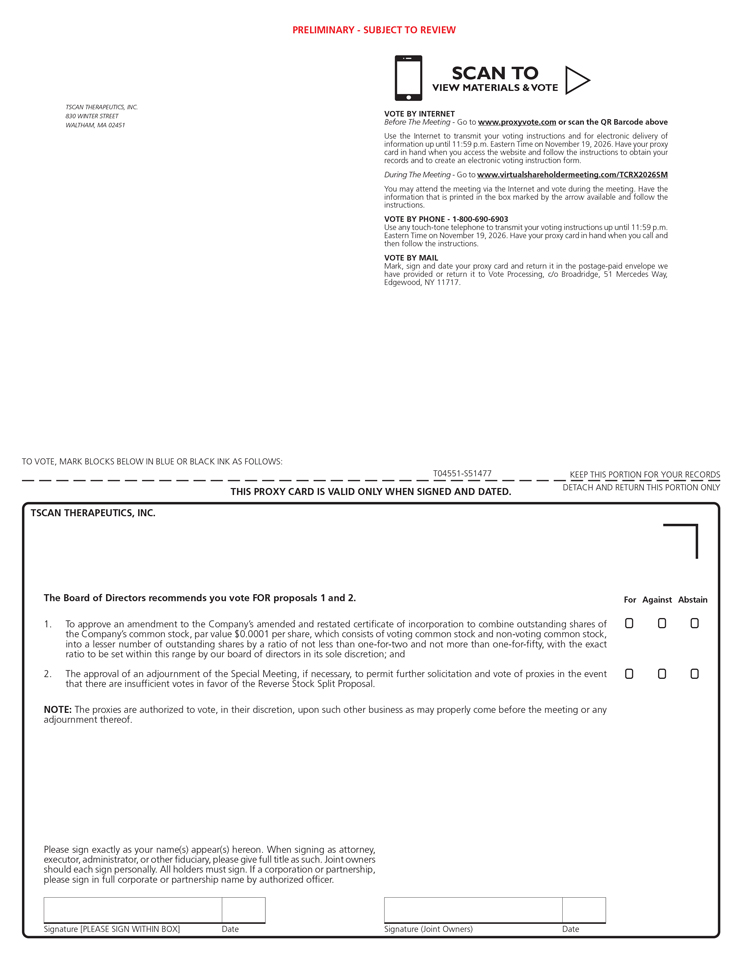
PRELIMINARY - SUBJECT TO REVIEW
TSCAN
THERAPEUTICS, INC. 830 WINTER STREET WALTHAM, MA 02451
SCAN TO VIEW MATERIALS & VOTE
VOTE BY INTERNET Before The Meeting - Go to www.proxyvote.com or scan the QR Barcode above Use the Internet to transmit your voting instructions and for electronic delivery of
information up until 11:59 p.m. Eastern Time on November 19, 2026. Have your proxy card in hand when you access the website and follow the instructions to obtain your records and to create an electronic voting instruction form. During The Meeting -
Go to www.virtualshareholdermeeting.com/TCRX2026SM You may attend the meeting via the Internet and vote during the meeting. Have the information that is printed in the box marked by the arrow available and follow the instructions. VOTE BY PHONE -
1-800-690-6903 Use any touch-tone telephone to transmit your voting instructions up until 11:59 p.m. Eastern Time on November 19, 2026. Have your proxy card in hand when you call and then follow the instructions. VOTE BY MAIL Mark, sign and date
your proxy card and return it in the postage-paid envelope we have provided or return it to Vote Processing, c/o Broadridge, 51 Mercedes Way, Edgewood, NY 11717.
TO VOTE, MARK BLOCKS BELOW IN BLUE OR BLACK INK AS FOLLOWS:
T04551-S51477
KEEP THIS PORTION FOR YOUR RECORDS
DETACH AND RETURN THIS PORTION ONLY
THIS PROXY CARD IS VALID ONLY WHEN SIGNED AND DATED.
TSCAN THERAPEUTICS, INC.
The Board of Directors recommends you vote FOR proposals 1 and 2.
1. KEEP
THIS PORTION FOR YOUR RECORDS DETACH AND RETURN THIS PORTION ONLY To approve an amendment to the Company’s amended and restated certificate of incorporation to combine outstanding shares of the Company’s common stock, par value $0.0001
per share, which consists of voting common stock and non-voting common stock, into a lesser number of outstanding shares by a ratio of not less than one-for-two and not more than one-for-fifty, with the exact ratio to be set within this range by our
board of directors in its sole discretion; and
2. The approval of an adjournment of the Special Meeting, if necessary, to permit further solicitation and vote of
proxies in the event that there are insufficient votes in favor of the Reverse Stock Split Proposal.
NOTE: The proxies are authorized to vote, in their discretion,
upon such other business as may properly come before the meeting or any adjournment thereof.
Please sign exactly as your name(s) appear(s) hereon. When signing as
attorney, executor, administrator, or other fiduciary, please give full title as such. Joint owners should each sign personally. All holders must sign. If a corporation or partnership, please sign in full corporate or partnership name by authorized
officer.
For Against Abstain
Signature [PLEASE SIGN WITHIN BOX]
Date
Signature (Joint Owners)
Date
Table of Contents
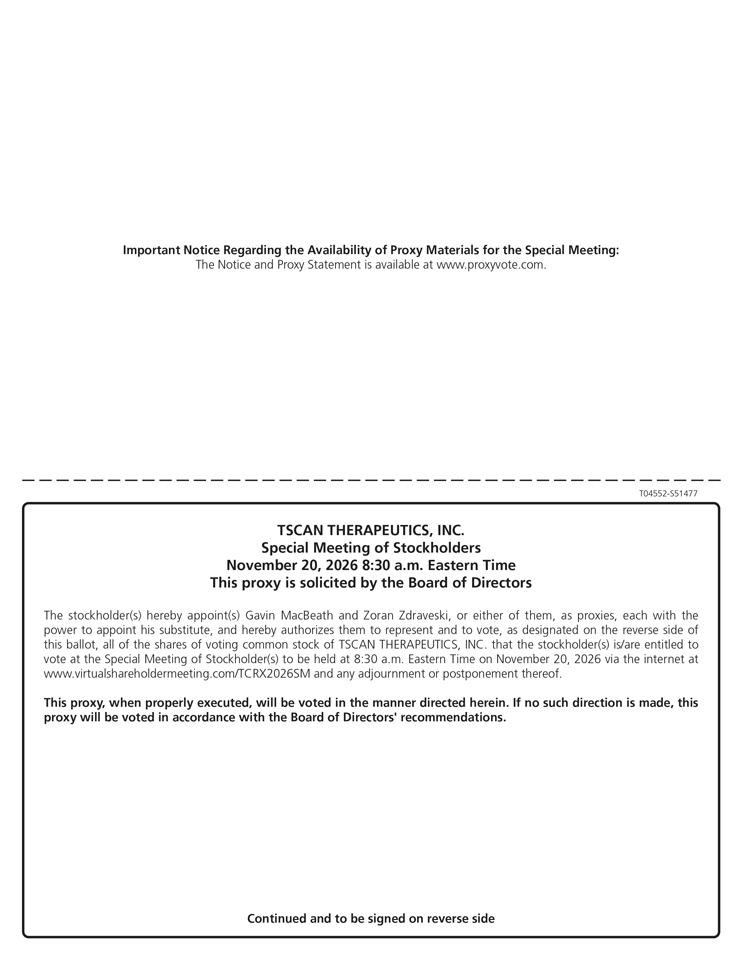
Important Notice Regarding the Availability of Proxy Materials for the Special Meeting: The Notice and Proxy Statement is available at
www.proxyvote.com.
T04552-S51477
TSCAN THERAPEUTICS, INC. Special Meeting of
Stockholders November 20, 2026 8:30 a.m. Eastern Time This proxy is solicited by the Board of Directors
The stockholder(s) hereby appoint(s) Gavin MacBeath and
Zoran Zdraveski, or either of them, as proxies, each with the power to appoint his substitute, and hereby authorizes them to represent and to vote, as designated on the reverse side of this ballot, all of the shares of voting common stock of TSCAN
THERAPEUTICS, INC. that the stockholder(s) is/are entitled to vote at the Special Meeting of Stockholder(s) to be held at 8:30 a.m. Eastern Time on November 20, 2026 via the internet at www.virtualshareholdermeeting.com/TCRX2026SM and any
adjournment or postponement thereof.
This proxy, when properly executed, will be voted in the manner directed herein. If no such direction is made, this proxy will
be voted in accordance with the Board of Directors’ recommendations.
Continued and to be signed on reverse side